The Power of Invention: Bringing the Happy Toilet Brand to Life
- Posted by Wanda Lenoir
- On November 8, 2026
- Happy Toliet Brand
By Wanda Lenoir
The Power of Invention: Bringing the Happy Toilet Brand to Life
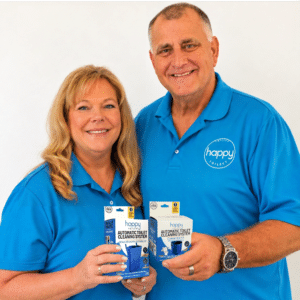
We seldom think about the clever people who invent the gadgets and gizmos that solve everyday problems that homeowners typically encounter. Truth be told, inventors don’t wake up and say, “I feel like creating something today.” Most of the time, folks are simply trying to figure out the easiest way to get from point A to point B on a frustrating DIY project. Or they’re a Master Plumber, like Chris Stanfield, who used his knowledge to develop a product that helps his wife Linda and their customers follow the advice he’s been sharing for 40 years. The Happy Toilet Cleaning Tablet Dispenser is a labor of love for the dynamic duo.
We’re all in this industry together. CEP Magazine is committed to highlighting new vendors who play a critical role in strengthening the supply chain. Find out what it takes to be an inventor by reading Chris and Linda’s story.
What motivated Chris to invent the Happy Toilet Cleaning Tablet Dispenser? What everyday problem did you want to solve?
Chris has been a licensed Master Plumber for more than 40 years, and together we owned and operated a plumbing company for more than 35 years. During that time, Chris repaired thousands of toilets and saw firsthand the damage that traditional drop-in tank cleaning tablets can cause to rubber seals, flappers, and other working parts inside the toilet tank.
The idea for Happy Toilet actually started at home. I brought home toilet cleaning tablets, even though Chris had warned me about putting chemicals directly into the toilet tank. Instead of simply telling me not to use them, Chris started thinking, “There has to be a better way.”
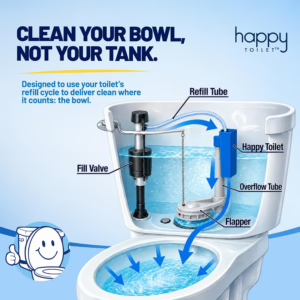
About an hour later, he created the basic concept for what would become Happy Toilet: keep the cleaning tablet separate from the tank water and use the toilet’s refill water to deliver cleaning solution directly into the bowl after every flush. We weren’t trying to invent another toilet cleaner. We wanted to change how the toilet gets cleaned.
How does the dispenser work?
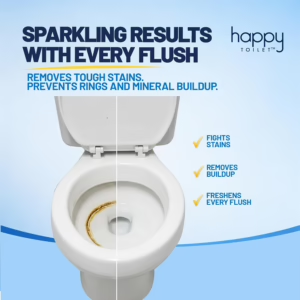
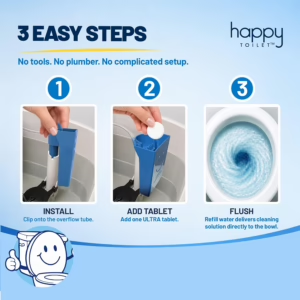
Happy Toilet automatically introduces cleaning solution into the toilet bowl with every flush while keeping the tablet away from sensitive tank components. Because the cleaning solution travels with water into areas of the bowl that are difficult or impossible to reach manually—including beneath the rim and through internal bowl passageways—Happy Toilet can clean areas of the toilet better than we can manually.
Linda, how did you support Chris’s dream of becoming an inventor?
I believed in Chris because I had watched him solve difficult plumbing problems for decades. He has always been the person people call when they can’t figure something out. But inventing a product and building a company around an invention are two very different things.

Happy Toilet Automatic Cleaning System
You two now work together. When did that happen?
Chris focused heavily on how the product worked — the plumbing, water flow, function, and design. My role was to help turn the invention into something consumers could understand, buy, and use. That includes branding, marketing, customer communication, sales, retailer relationships, and trade shows. Most importantly, I reminded Chris that an invention can’t help anyone if nobody knows it exists! We really complement each other. Chris often sees a problem from the plumber’s side, while I tend to look at it from the homeowner’s side. Together we ask: Does it work, is it easy to understand, and will it make someone’s life easier?
How many prototypes did you create before perfecting the final design?
We went through approximately 7 prototypes and design variations before reaching the production design. And even when you think you have the final design, you keep learning.
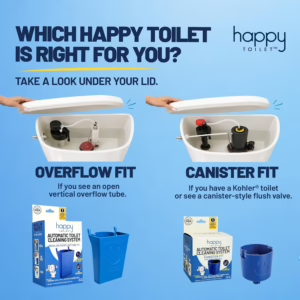
Toilets look simple from the outside, but there are many different flushing systems, tank configurations, overflow tubes, and refill arrangements. Small changes in dimensions can make a big difference. That process eventually led us to develop two different Happy Toilet designs rather than trying to force one product to fit every toilet. Inventors must be willing to change the design even when they think it is already finished.
What are the biggest mistakes inventors make when moving from prototype to production? One of the biggest mistakes is falling in love with the prototype and moving to expensive production tooling too quickly. A prototype may work perfectly in your own hands, but manufacturing thousands of identical parts is completely different. You must consider tolerances, materials, assembly, packaging, and shipping. The most important thing is understanding how real consumers will use the product.
Another mistake is designing the product without thinking about manufacturing cost. A small design change can sometimes make a huge difference in tooling or production cost. Our advice is: test it, change it, test it again, and listen to people who will use the product before committing to large-scale production. It’s also critical to protect your intellectual property. If you believe you have created something truly different, talk with qualified professionals about patents and trademarks early in the process.
What challenges did you need to overcome to bring the dispenser to market?
One of our biggest challenges was the enormous variety of toilets in American homes. People tend to think a toilet is a toilet, but once you open the tank, there are many different flushing systems. We wanted Happy Toilet to be simple for the homeowner while still working correctly with the plumbing system. We also dealt with the normal challenges every new product company faces: prototypes, tooling, manufacturing, packaging, educating consumers, and getting retailers to understand a product category that didn’t really exist before.
Another important lesson was that education and customer service are part of the product. When customers have questions, we often ask them to send us a photograph of the inside of their toilet tank. We can usually identify the flushing system and help them determine which Happy Toilet design they need. We didn’t just want to sell someone a product. We wanted to make sure they could use it successfully.
Why is the Happy Toilet Cleaning Tablet Dispenser a good fit for hardware stores?
We think Happy Toilet is an especially good fit for independent hardware stores because hardware-store customers come in looking for solutions. Someone may walk in because their toilet is dirty, they have toilet bowl rings, they are tired of scrubbing, they are buying cleaning tablets, or they are replacing a flapper or another toilet component. Happy Toilet connects the toilet repair and cleaning categories in a way very few products do.
It also gives store employees a product that’s easy to explain: We automatically clean our dishes. We automatically clean our clothes. Now we can let the toilet help automatically clean the toilet bowl too. Instead of dropping a cleaning tablet into the tank, as millions of people already do, where the chemical sits around working toilet components, Happy Toilet keeps the tablet contained and uses refill water to deliver the cleaning solution where it belongs—into the toilet bowl. For retailers, another important benefit is that the dispenser creates an opportunity for repeat tablet sales.
What advice would you give someone who wants to become an inventor?
Chris: Start with a real problem. Don’t begin by asking, “What can I invent?” Pay attention to the things people complain about, struggle with, or accept because they think there isn’t a better way. Then build something. Your first version doesn’t have to be pretty. It must teach you something. Test it in the real world. Listen to customers. Protect your intellectual property. Find knowledgeable people who will challenge your assumptions. And don’t be afraid to redesign something you thought was finished. Most importantly, understand that inventing the product may be the easy part. Bringing it to market requires persistence, manufacturing, marketing, sales, customer service, and a willingness to keep learning.
Linda: And I would add one more thing: sometimes the inventor needs someone beside them who believes the idea can become a business. Chris invented Happy Toilet because I brought home something he told me not to put in our toilet tank. So technically, I like to remind him that I created the problem — and he invented the solution.